Building a responsible crypto mining facility begins with engineering discipline, not simply buying more machines. This guide explains how to build a crypto mining facility efficiently while protecting workers, equipment, nearby communities, and the local power grid. A practical plan starts with a documented energy assessment, verified utility capacity, and professional advice from licensed electricians, structural engineers, and thermal specialists. Local permits, zoning rules, fire standards, noise limits, tax obligations, and environmental requirements must be checked before construction begins.
Efficiency becomes visible in small physical details. A well-planned room separates cold intake air from hot exhaust air. It leaves clear service aisles around each rack. It measures power usage at the panel, rack, and machine levels. Operators can track temperature, humidity, fan speed, downtime, and power usage effectiveness through calibrated monitoring systems. Renewable electricity may reduce emissions, but its availability, reliability, and contract terms require careful verification. Backup systems should support safe shutdowns rather than encourage uncontrolled expansion.
No design is perfect. Early energy forecasts can be wrong. Cooling performance may change during summer heat. Noise can travel farther than expected. These risks deserve testing before full deployment. A small pilot room can reveal airflow problems, unstable circuits, and maintenance delays. Independent inspections and transparent operating records strengthen credibility. The strongest facility is not the loudest or largest. It is measurable, maintainable, legally compliant, and prepared to improve when real operating data challenges the original plan.
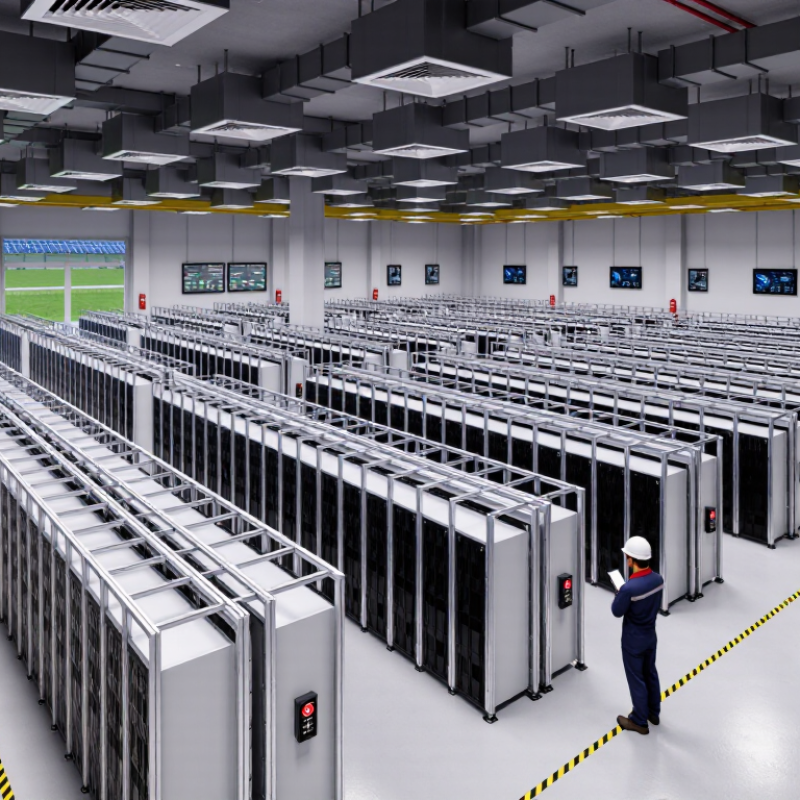
Building an energy-efficient crypto mining facility starts with an honest load estimate. Cambridge Centre for Alternative Finance estimated Bitcoin mining consumed about 176 TWh in 2023. That figure shows how quickly small planning errors become expensive. Calculate miner demand, cooling, ventilation, networking, lighting, and transformer losses. A 10 MW mining load may require 11–13 MW at the grid connection. It sounds conservative. It may still be wrong.
Hardware efficiency matters more than nameplate capacity. Compare machines by joules per terahash, not only purchase price. Modern equipment commonly operates near 15–25 J/TH, while older units can exceed 40 J/TH. Model seasonal performance at full, partial, and curtailed power. Uptime Institute’s 2024 survey reported average data-center PUE near 1.6, so a mining site targeting 1.2–1.3 would need disciplined cooling design. Air cooling may work in a dry climate. Humid locations can increase maintenance and fan energy.
Site selection should begin with grid evidence, not cheap land. Request documented capacity, connection timelines, outage history, tariff structures, and curtailment rules. Check nearby substations, flood maps, wildfire risk, water stress, and noise limits. Cooler weather can reduce cooling demand, but harsh winters may raise heating and maintenance costs. The International Energy Agency expects data-center, artificial-intelligence, and cryptocurrency electricity demand to rise sharply through 2026. This makes local grid impact a practical concern. Renewable supply is useful, but hourly matching matters more than annual certificates. A weak assumption here can undermine an otherwise efficient design.
Annual electricity requirements for a facility with a constant 10 MW mining load under different Power Usage Effectiveness (PUE) scenarios.
The calculation uses 8,760 operating hours per year: annual electricity use = mining load × hours × PUE. A lower PUE means less electricity is consumed by cooling, power distribution, lighting, and other facility systems. For a 10 MW mining load, reducing PUE from 1.30 to 1.05 saves approximately 21,900 MWh per year.
An efficient mining facility begins with measured heat, not theoretical rack capacity. Every computing unit converts nearly all incoming electricity into heat. The International Energy Agency reports that data centers consumed about 415 TWh globally in 2024. That demand makes cooling design a financial decision, not a cosmetic upgrade.
Airflow must follow a simple path: cool air enters the equipment face, and hot air exits without mixing. Use sealed aisles, blanking panels, and roof-level exhaust fans.
Maintain server inlet temperatures within the applicable ASHRAE TC 9.9 guidance, commonly 18–27°C for recommended air-cooled operation. Shorter airflow paths reduce fan energy. Small gaps can quietly ruin performance.
Power distribution deserves equal attention. Medium-voltage service can reduce upstream losses, while properly sized transformers limit unnecessary conversion waste. Place metering at the utility entrance, each distribution board, and every mining row.
The Uptime Institute’s 2024 Global Data Center Survey reported an average PUE of approximately 1.56, showing that non-computing energy remains significant. A lower PUE is useful, but it can hide poor electrical reliability.
Use selective redundancy rather than duplicating everything. Oversized backup systems consume energy and capital. Harmonic filtering, phase balancing, and protection coordination require engineering review.
Liquid cooling may improve density, but leaks and maintenance access need serious planning. A perfect design is unrealistic.
Commissioning should test airflow, thermal alarms, voltage sag, and restart behavior under real load, not only simulated conditions.
Building an energy-efficient crypto mining facility starts with hardware efficiency, not floor space. Compare machines by joules per terahash (J/TH), then test performance at different power limits. A 20 J/TH unit can deliver about 50 petahashes per second from one megawatt, before cooling and electrical losses. Undervolting may reduce output, but it often improves efficiency and hardware life. Measure real results for two weeks. Specifications are not operating data.
Infrastructure decides whether those gains survive. Design short electrical paths, high-efficiency transformers, and modular racks with clear airflow. Liquid cooling can reduce fan power and stabilize temperatures, but pumps add their own load. Keep sensors on every rack. A small temperature imbalance can quietly increase failure rates. The Uptime Institute’s Global Data Center Survey 2024 reported an average PUE of about 1.56, while efficient new facilities can target nearly 1.2 with disciplined design. That gap matters: a 1 MW mining load may require roughly 1.2 MW or more at the facility level. Cambridge Centre for Alternative Finance reported that sustainable energy supplied 52.6% of surveyed Bitcoin mining electricity in its 2024 industry report. Renewable access helps, but it does not excuse waste. I would challenge any design relying only on annual energy certificates. Real-time power data, repair logs, and seasonal grid conditions tell a less comfortable story.
| System Area | Key Dimension | Recommended Design Target | Reference Value | Energy-Efficiency Consideration |
|---|---|---|---|---|
| Mining Hardware | ASIC energy efficiency | Use current-generation SHA-256 hardware with low joules per terahash. | Approximately 15–25 J/TH | Lower J/TH means less electricity is required to produce the same computing output. |
| Mining Hardware | Operating power per miner | Match the miner fleet to the electrical capacity and cooling design. | Approximately 3–4 kW per high-performance unit | Use power distribution equipment with sufficient continuous-load capacity and thermal headroom. |
| Mining Hardware | Underclocking and power tuning | Operate miners at a stable efficiency point rather than maximum frequency. | Typical reduction: 10–30% in power draw | Power tuning can reduce heat output and improve J/TH, although hashrate also decreases. |
| Mining Hardware | Fleet utilization | Maintain high availability through preventive maintenance and spare parts. | Target: 95% or higher uptime | Higher availability spreads facility overhead across more productive computing hours. |
| Electrical Infrastructure | Power supply efficiency | Select high-efficiency power supplies sized for the actual continuous load. | Approximately 94–97% conversion efficiency | Efficient power supplies reduce conversion losses that otherwise become additional heat. |
| Electrical Infrastructure | Power distribution losses | Use appropriately sized transformers, busways, conductors, and short distribution paths. | Design target: below 2% distribution loss | Lower resistive losses improve delivered power efficiency and reduce unnecessary thermal load. |
| Cooling Infrastructure | Air-cooling operating range | Use filtered airflow, hot-aisle containment, and variable-speed fans. | Approximately 18–27°C supply air | Containment prevents hot and cold air mixing, allowing fans and cooling equipment to operate more efficiently. |
| Cooling Infrastructure | Direct liquid or immersion cooling | Use liquid cooling where rack density, noise, or local climate makes air cooling inefficient. | Cooling energy reduction can reach approximately 5–20% | Results vary by climate, heat exchanger design, pump power, and whether mechanical refrigeration is required. |
| Cooling Infrastructure | Cooling system efficiency | Prefer free cooling, evaporative cooling, or dry coolers where local conditions permit. | Cooling overhead target: 3–10% of IT load | Free-cooling hours can significantly reduce compressor operation and seasonal energy consumption. |
| Facility Design | Power Usage Effectiveness (PUE) | Measure total facility energy against mining equipment energy. | Efficient target: 1.05–1.15 | A PUE of 1.10 means the facility uses 1.10 kWh for every 1.00 kWh consumed by mining equipment. |
| Facility Design | Rack and container density | Set density according to cooling capacity, cable loading, and fire-safety requirements. | Approximately 20–40 kW per rack or module | Higher density can reduce building area but requires stronger airflow, liquid cooling, or both. |
| Facility Design | Modular expansion | Build in repeatable electrical and cooling blocks instead of oversizing the entire facility. | Expansion blocks of approximately 250–1,000 kW | Phased construction reduces idle infrastructure and allows capacity to follow available power and equipment efficiency. |
| Energy Procurement | Low-carbon electricity sourcing | Prioritize verifiable renewable generation, long-term contracts, or low-carbon grid regions. | Documented hourly or annual matching preferred | Energy efficiency lowers consumption first; transparent sourcing then reduces the emissions intensity of remaining demand. |
| Energy Management | Demand response capability | Use software-controlled curtailment during high-price or high-carbon grid periods. | Flexible load: 10–30% of site capacity | Mining loads can often be reduced quickly, helping avoid expensive peak electricity and supporting grid stability. |
| Monitoring and Controls | Real-time energy measurement | Measure power, temperature, hashrate, fan speed, and efficiency at circuit or device level. | Sampling interval: 1–5 minutes | Granular data helps identify failing equipment, cooling imbalance, abnormal power draw, and inefficient operating modes. |
| Heat Recovery | Waste-heat utilization | Connect liquid-cooled systems to low-temperature heating loads where practical. | Useful heat commonly available at 40–70°C | Recovered heat can support greenhouses, water preheating, or nearby buildings when a suitable thermal demand exists. |
| Lifecycle Management | Hardware replacement threshold | Retire or repurpose equipment when operating efficiency no longer covers energy and maintenance costs. | Evaluate at least quarterly | Profitability and environmental performance depend on electricity price, network difficulty, uptime, and actual J/TH. |
A practical facility begins with an hourly energy study, not a large equipment order. Record mining demand, cooling loads, seasonal sunlight, and local grid limits. This profile reveals when renewable power can cover operations. It also exposes uncomfortable gaps during cloudy afternoons.
Solar panels can supply daytime computing, while batteries shift excess generation into evening hours. A small wind system may support winter production where site conditions allow. However, renewable capacity should match measured demand, not optimistic forecasts. Oversizing equipment creates unused power and higher maintenance costs. That mistake is easy to make.
Smart power management coordinates miners, batteries, cooling, and backup supplies through live monitoring. Controllers can reduce computing intensity when electricity prices rise or renewable output falls. Temperature sensors should adjust airflow before hardware reaches damaging heat levels. Keep separate meters for each circuit. Clear data makes faults easier to find and budgets easier to defend. The system should also protect batteries from deep discharge and limit sudden load changes. These safeguards improve reliability, although they add setup complexity. A simple dashboard may be less impressive, but operators usually understand it faster. Performance reviews should compare predicted and actual energy use every month. Some assumptions will fail. That is useful information.
Energy efficiency starts with measurement, not louder cooling fans. Track electricity use at the utility meter, distribution panels, and mining racks. Compare real-time load with hash rate every five minutes. This reveals idle machines, unstable power supplies, and cooling losses. The International Energy Agency reported that data centres, artificial intelligence, and cryptocurrency consumed about 460 TWh globally in 2022. Demand could exceed 1,000 TWh by 2026. Small inefficiencies will become expensive.
Use PUE to measure facility overhead, but do not treat it as a perfect answer. PUE divides total facility energy by information technology energy. It can improve while mining hardware performs poorly. Track hash rate per kilowatt-hour, temperature variation, fan speed, and rejected shares together. A 2024 industry survey from Uptime Institute reported an average data-centre PUE near 1.56. A mining facility should investigate every gap above its internal baseline. Yet, a lower number is not automatically better. Sensors may be poorly placed. Dashboards can still lie.
Tips: Install calibrated meters before expanding capacity. Review weekly trends, not single-day records. Clean filters before increasing fan speed. Test airflow with smoke or simple ribbons. Set alerts for abnormal wattage and temperature. Replace underperforming machines only after checking firmware, power quality, and ambient heat. The Cambridge Digital Mining Industry Report highlights energy sourcing and operational efficiency as important sustainability factors. Keep those records independently verifiable. Perfect data is unrealistic. Better data is achievable.
Nearly all electricity entering computing equipment becomes heat. Measure actual heat output before sizing racks, fans, or cooling systems. Theoretical capacity can mislead.
Cool air should enter equipment fronts and hot air should leave without mixing. Sealed aisles, blanking panels, and roof exhaust fans help. Small gaps matter.
Keep server inlet temperatures within the applicable operating guidance, commonly around 18–27°C. Check readings at equipment faces, not only room walls. Hot spots may remain hidden.
Use appropriately sized transformers and consider medium-voltage service where suitable. Install meters at the utility entrance, distribution boards, and mining rows. Measurement exposes waste.
A lower value usually indicates less non-computing energy consumption. However, it may hide weak electrical reliability or poor maintenance. Efficiency alone is incomplete.
Not always. Selective redundancy can reduce capital costs and unnecessary energy use. Oversized backup equipment may sit idle while creating maintenance burdens.
Start with an hourly energy study covering computing demand, cooling, sunlight, and grid limits. Solar can support daytime loads, while batteries shift surplus power. Cloudy afternoons remain difficult.
It should coordinate computing equipment, batteries, cooling, and backup supplies through live monitoring. Controllers can reduce computing intensity during high prices or low renewable output. Simple dashboards often work better.
Commissioning should test airflow, thermal alarms, voltage sag, and restart behavior under real load. Simulations are useful, but they are not enough. Some assumptions will fail. That is valuable.
Building an energy-efficient crypto mining facility begins with a careful assessment of electricity demand, cooling needs, local climate, grid reliability, and operating costs. Selecting a site with access to stable, reasonably priced power and favorable environmental conditions can significantly reduce energy waste. The facility should then be designed around efficient airflow, effective heat removal, insulated structures, and balanced power distribution to prevent equipment stress and unnecessary consumption.
To understand how to build a crypto mining facility efficiently, operators should choose energy-conscious mining hardware, high-quality power supplies, and infrastructure that minimizes conversion losses. Renewable energy sources, battery storage, and smart power management can further improve sustainability by adjusting operations according to energy availability and demand. Continuous monitoring of temperature, power usage, hardware performance, and maintenance requirements helps identify inefficiencies early. Regular upgrades, responsible equipment management, and long-term energy reviews ensure that the facility remains reliable, cost-effective, and environmentally responsible.

CasaDe Home